Saving time saves lives.
A wearer-initiated aerial marker that follows the casualty through the avalanche. It launches from the user’s equipment, tracks movement through the slide and marks the final burial position – turning a search area into a visible target.
The window is measured in minutes.
Eurac / WSL research analysing 1,643 critically buried avalanche victims in Switzerland (1981–2020) shows survival probability collapsing as search time increases. The signal and coarse-search phases consume the most valuable minutes — precisely the minutes AVADRONE returns.
EURAC / WSL RESEARCH (CONDUCTED BY RAUCH ET AL.) — “AVALANCHE SURVIVAL RATES IN SWITZERLAND, 1981–2020” · N=1,643 · JAMA NETWORK OPEN, 2024
Where the minutes actually go.
Existing equipment is VITAL – but it still leaves search time in the chain. Every phase below has to happen before a casualty can be reached, and the clock starts the moment the snow moves.
Avalanche triggers
Slide stops, debris settles +0:30
Survivors orient, mark the last-seen point and switch transceivers to search.
Signal search +0:30 – 1:00
Sweep the deposit until a transceiver signal is acquired.
Coarse search +1:00 – 1:30
Follow the flux line in to roughly three metres.
Fine search +0:30 – 0:45
Cross-pattern at the snow surface to the lowest reading.
Probe strike +0:30 – 0:45
Confirm position and depth. Average burial is 1–1.3m.
Casualty reached +4:00 – 5:30
Shovelling — over half the rescue, and the phase no search tool shortens.
A companion rescue averages 10 minutes because someone is already on the surface. When the rest of the party is buried, injured or the skier was alone, the clock belongs to professional rescue – which averages 90 minutes. The Eurac / WSL research found the risk of dying from suffocation between 10 and 30 minutes of burial has not improved in four decades.
AVADRONE is designed to bypass the signal and coarse search altogether. Instead of searching for a signal, whoever reaches the slope – companion or professional – arrives at an already-marked position and starts digging. On the figures above that is a fifth to a quarter of the entire rescue, and it is the part that degrades worst in poor visibility, complex terrain and multiple burials. Survival falls steeply after ten minutes, so every minute handed back to the dig is a minute on the right side of the curve.
No new tool has entered this process in 40 years.
Every piece of equipment a rescuer reaches for today was introduced between 1968 and 1986. The kit has been refined – the process has not changed.
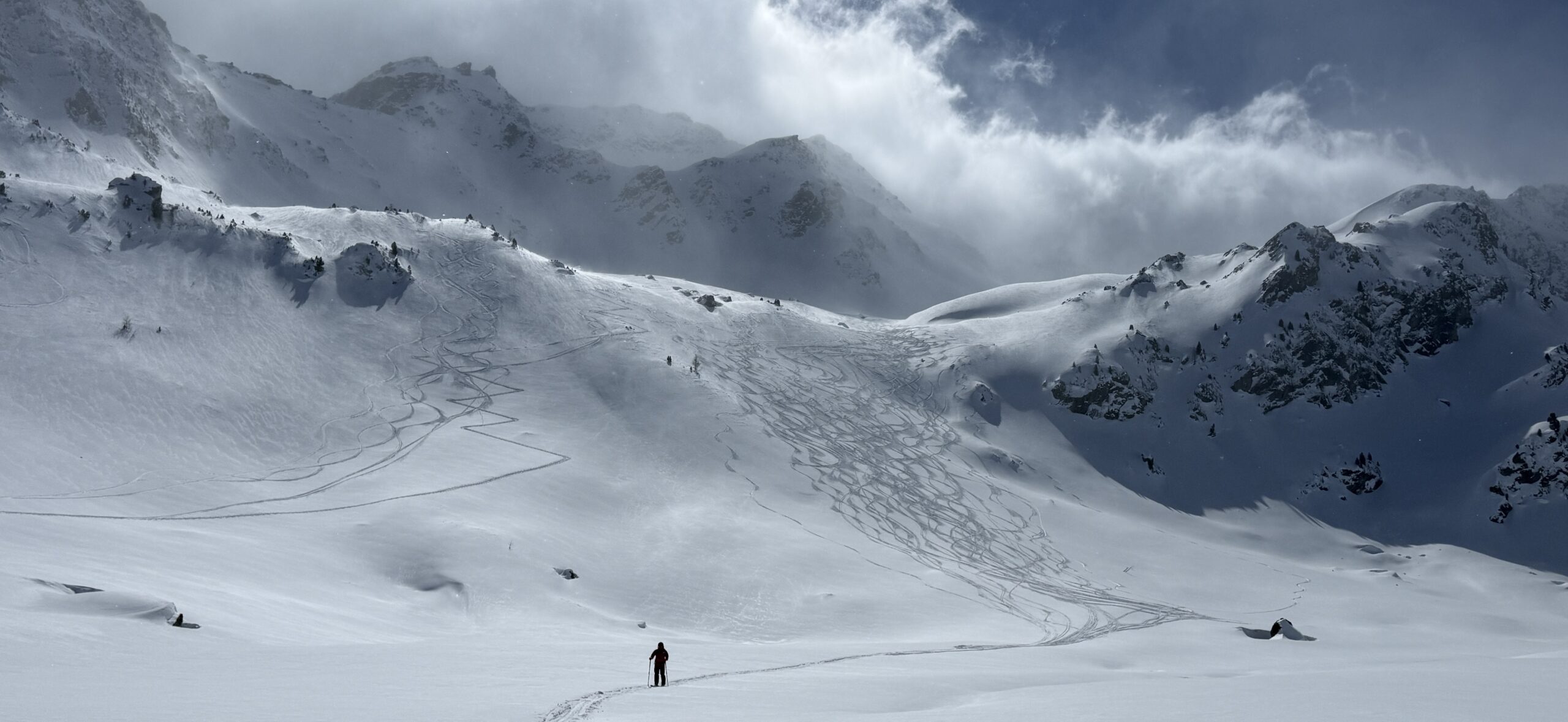
More people. Congested terrain. Rising fatalities.
These numbers are not a list – they are all important issues that are changing the shape of backcountry adventure. Closing lifts and ski areas and shorter seasons, both through climate change, push a growing number of skiers onto less terrain, and the overflow goes where nobody is patrolling.
Over the past five years
Projected by 2050
Disused ski lifts in Italy alone · from 131 in 2020
Over the same five years
25/26 season · up from 87 and 70
Buyers already pay for avalanche safety. AVADRONE is a premium layer alongside transceivers, airbags and RECCO — not a new category to create.
SOURCES // EAWS FATALITIES 2025/26 · INTEL MARKET RESEARCH, ALPINE TOURING SKIS MARKET 2026 · SIA PARTICIPATION STUDY 2023–24 · EESI 2026 · LEGAMBIENTE NEVEDIVERSA 2026 · BUSINESS RESEARCH INSIGHTS
An active marking layer.
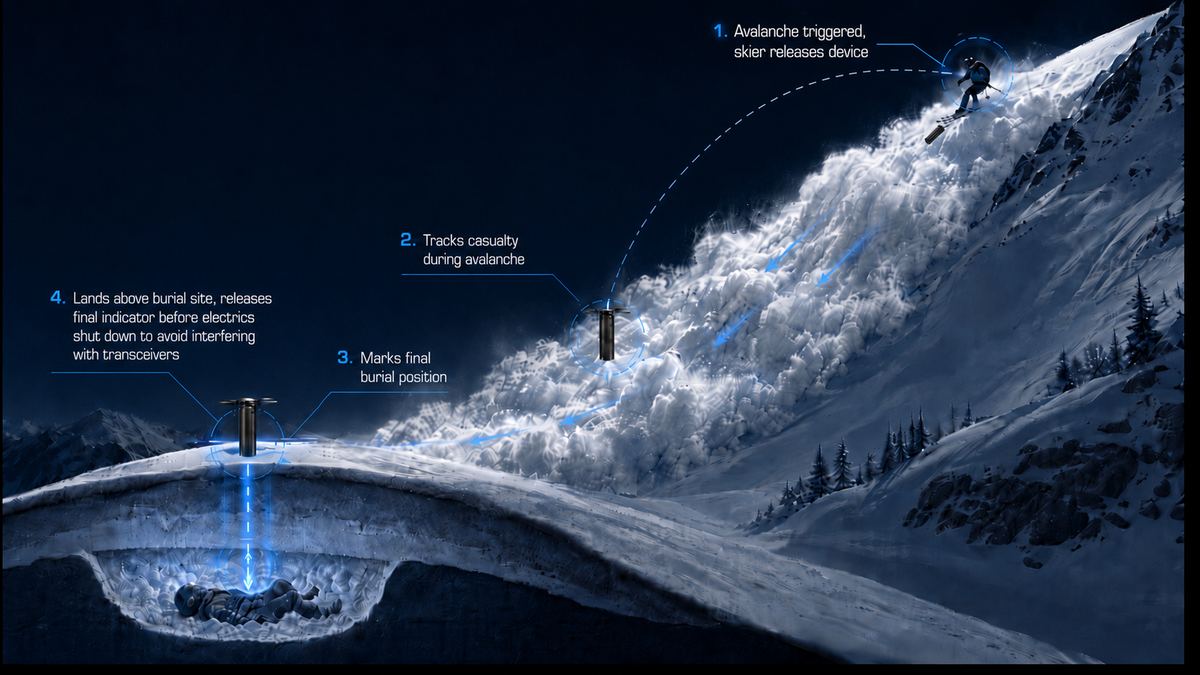
AVADRONE launches from the user’s equipment the instant an avalanche triggers. It tracks movement through the slide, marks the final burial position on the surface, then powers down to minimise interference with transceiver searches.
It works alongside transceivers, airbags, probes and RECCO – removing the search delay no existing tool can.
- Shoulder-strap trigger module for fast activation, attachable to existing airbag releases
- Multiple sensors
- Inertial sensing and 457 kHz beacon, designed to work with transceivers, processing to estimate final burial position
- Deployable marking system to indicate position
- Sub-1kg all-up weight, integrated into the pack
WHY NOW // MICRO-DRONE MINIATURISATION, IMPROVED IMU SENSORS AND 457 kHz SIGNAL PROCESSING HAVE ONLY RECENTLY MADE THIS TECHNICALLY FEASIBLE AT WEARABLE SCALE. THE CHALLENGE IS INTEGRATION, NOT INVENTION.
Deploys the instant a slide triggers
The moment the snow moves, the device releases from the pack and launches — no input required beyond the trigger.
Follows the casualty through the slide
The system tracks the person as they are carried down the mountain within the moving snowpack.
Marks the exact burial position
It pinpoints and marks the precise surface location where the casualty comes to rest.
Lands, indicates, then stands down
It lands above the burial site, marks the position, then powers down its electronics to avoid interfering with rescuers’ transceivers.
One concept, many theatres.
The active marking layer is domain-agnostic. Anywhere a person must be located and reached fast under adverse conditions – snow, rubble, terrain, or low visibility – the same release–track–mark loop applies. Avalanche rescue is the beachhead, not the ceiling.
Alpine & Backcountry
Individual touring skiers and splitboarders in unpatrolled, high-consequence terrain.
Ski Patrol & Resorts
Professional operators standardising rapid burial-marking across their patrolled boundaries.
Search & Rescue
Mountain rescue and SAR teams cutting the coarse-search phase in complex, multi-burial scenes.
Disaster Response
Rapid localisation of buried or trapped people in avalanche, landslide and collapse events.
Remote Industry & Expedition
Lone and small-team safety for expeditions, remote sites and cold-region operations.
A layer over the kit you already trust.
AVADRONE does not replace proven avalanche equipment. It compliments it – removing the search delay that limits every other tool in the chain.
Founder-led concept. IP filed. Technical scoping underway.
A defined concept with protected IP, an engaged technical partner ready to produce the prototype. The Form 9A search report is expected within three to six months of filing; the PCT application follows before the twelve-month priority deadline.
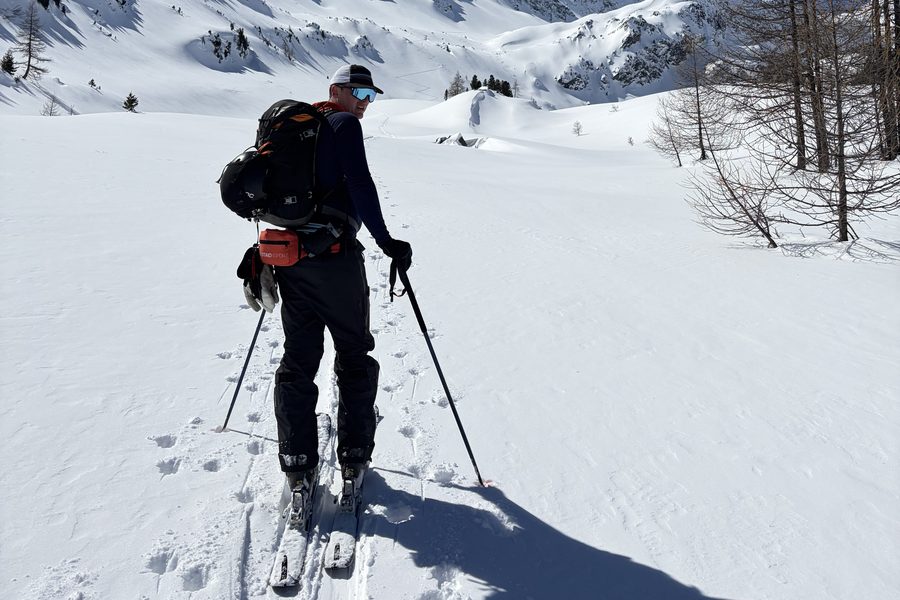

Connor Maxwell
Inventor of AVADRONE. BASI-qualified ski instructor and former British Infantry Officer decorated for bravery, with years of alpine and mountain-safety experience – now building a mission-led safety drone for avalanche rescue.
Twelve months to a flying MVP.
Four milestones down, five to go, across a 12-month MVP year. The same release–track–mark discipline behind the product applies to how the company is being built — sequential, de-risked, and gated on evidence at every step.
What this round buys:
A £250K raise funding a 12-month runway to a working, tested MVP. This round proves the rescue process – it does not build a production-ready product.
Intention to apply for SEIS
MVP milestone-driven
Prove the rescue process end to end
Release, launch, deployment, flight, tracking, mark, land and shut down – demonstrated as one working sequence, with orientation recovery and a sub-1kg payload validated.
Certification, manufacturing and launch
Consumer certification, avalanche-condition field validation and production tooling follow in a seed round raised on proven MVP evidence – not on this one.
From patent-filed concept, to a working tested MVP, to a seed round raised on hard evidence.
Be first as AVADRONE takes flight.
Whether you ski the backcountry, run a patrol or rescue team, or want to support the mission – register your interest for development and early-access updates. If you’re interested in investing, please email directly.